CER for Software as a Medical Device in the EU
The medical device industry has been changing bit by bit every day, and one of the significant changes is the […]

The medical device industry has been changing bit by bit every day, and one of the significant changes is the addition of technology to medical devices. While medical testing devices, scans, and robotic surgical instruments were already in use, they were mostly manual and user dependent. The use of the software is not new but certainly not very old.
Software used in conjunction with medical devices has become increasingly important over recent years, with many new applications developed to improve patient care in both hospitals and community settings.
Like any other medical device, the safe and effective use of the software is vital for patients and healthcare professionals alike.
Since this software is technically being used similarly to a medical device, the MDR sets out the requirements for ensuring their safety, efficacy, and quality for them, along with other medical devices.
Software as a medical device is software that performs or supports the functions of a medical device. This software may be embedded in a device, such as a pacemaker, or it may be used in conjunction with the device, such as an app for an iPhone that analyses and records data from the heart.
Even if it is a part of a medical device, the software has to have its own medical function to qualify as a medical device.
This software can include any type of computer program code (e.g., operating systems), firmware, etc. It also includes any information recorded on material media intended for use in digital devices intended for medical purposes. However, software that is not necessarily clinical or related to the patient directly, for example, payment-related software, is not considered SaMD.
The In vitro diagnostic device software devices are covered by the REGULATION (EU) 2017/746 (IVDR). SaMD, which works exclusively from data sourced by IVD devices, is considered within these regulations. Others fall under (EU) regulation 2017/745 or MDR.
The MDR classifies the medical device software into four categories: Class I (low risk), Class IIa (medium risk), Class IIb (medium/high risk), and Class III (high risk). Based on the categories, the requirements for clinical evaluation and performance evaluation reports also vary.
Softwares that factor in the physician’s decision-making regarding diagnosis or therapeutic purposes are considered class IIa. Software that works as a physiological processes monitor is classified as class IIa. The vital parameter monitors are considered class IIb.
Except for a few exclusion criteria, all other medical software is considered class I.
Each medical device software has to be assigned a UDI. Usually, it’s given on the system level of the software, as they are part of medical devices. The software that is individually commercially available will need a UDI assignment on its own.
The UDI is part of the manufacturing control mechanism, and the UDI-PI will display it. Major changes in the software like:
Other minor changes will need an update in the UDI-PI.
The clinical evaluation process for medical device software is pretty similar to other medical devices. Most of the medical device software is not high-risk class, so the requirements are, in fact, a bit lenient than high-risk devices. However, the notified body is involved. For a full framework of what a compliant SaMD CER looks like, [read our CER writing guide].
On the MDCG 2020-1 Guidance on Clinical Evaluation (MDR) / Performance Evaluation (IVDR) of Medical Device Software document, the Medical Device Regulation provided the following chart as the standard medical device clinical evaluation to-do for software as a medical device.
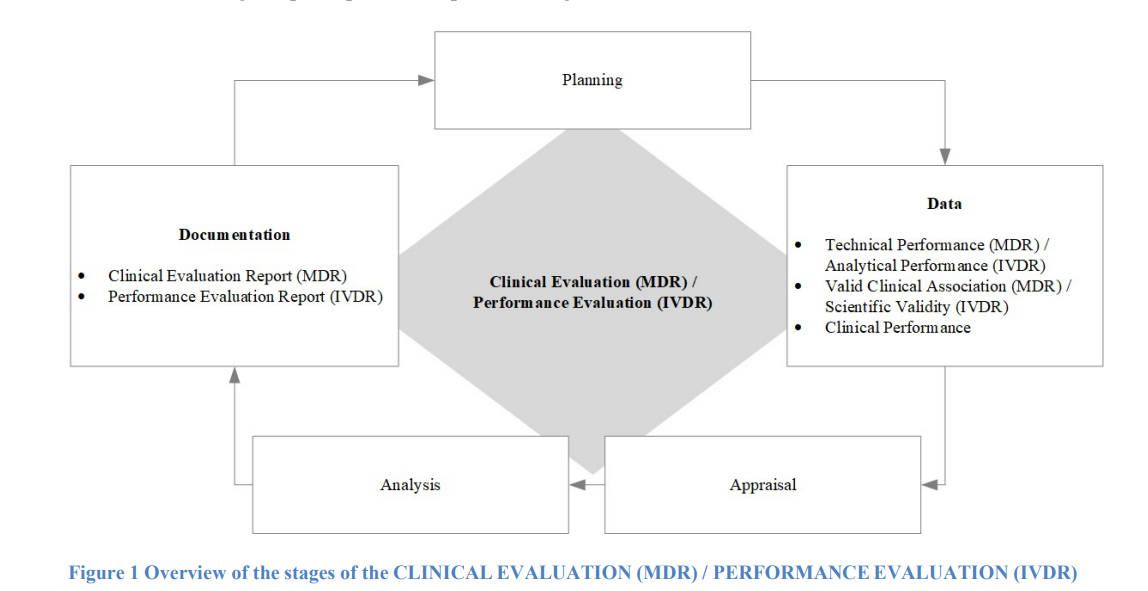
The CER of software as a medical device and regular medical devices are similar in their complexity, so we would suggest starting as prepared as you can. A checklist is always a great tool to have for streamlining the process. It will also ensure you do not forget all the small details required by software as a medical device.